Why Connecting Everything to ChatGPT Is Not a Company Brain
General AI assistants can now be connected to your drive, your chat and your email. So why would a company need anything more? The answer has nothing to do with which model is smarter. It is about what has to happen to a company's knowledge before any model can answer from it.
The obvious idea
The idea is reasonable. General assistants such as ChatGPT and Claude are very capable, and they now offer connectors to the tools companies already use. OpenAI, for example, describes its company knowledge feature as bringing information from apps like Slack, SharePoint and Google Drive into ChatGPT, while respecting each user's existing permissions.
So connect everything, and ask. For simple lookups this works well: find the deck from last quarter, summarise this thread, what does the contract say about notice periods.
The trouble starts with the questions that matter more, the ones where the answer is not sitting in one document.
The model is not the difference
It is worth being clear about what the difference is not. It is not that a specialised system has a better model. We use the same models. They are excellent at reading what they are given and answering from it.
That last part is the point. A model can only answer from what it is handed. Everything that determines whether the right material reaches it happens before the model is involved at all.
Knowledge is scattered across time, tools and people
What a company knows is rarely in one place. A pricing decision was made in an email thread two years ago. The current price is in a spreadsheet. The exception for one customer is in a contract. The reason for the exception is in someone's head.
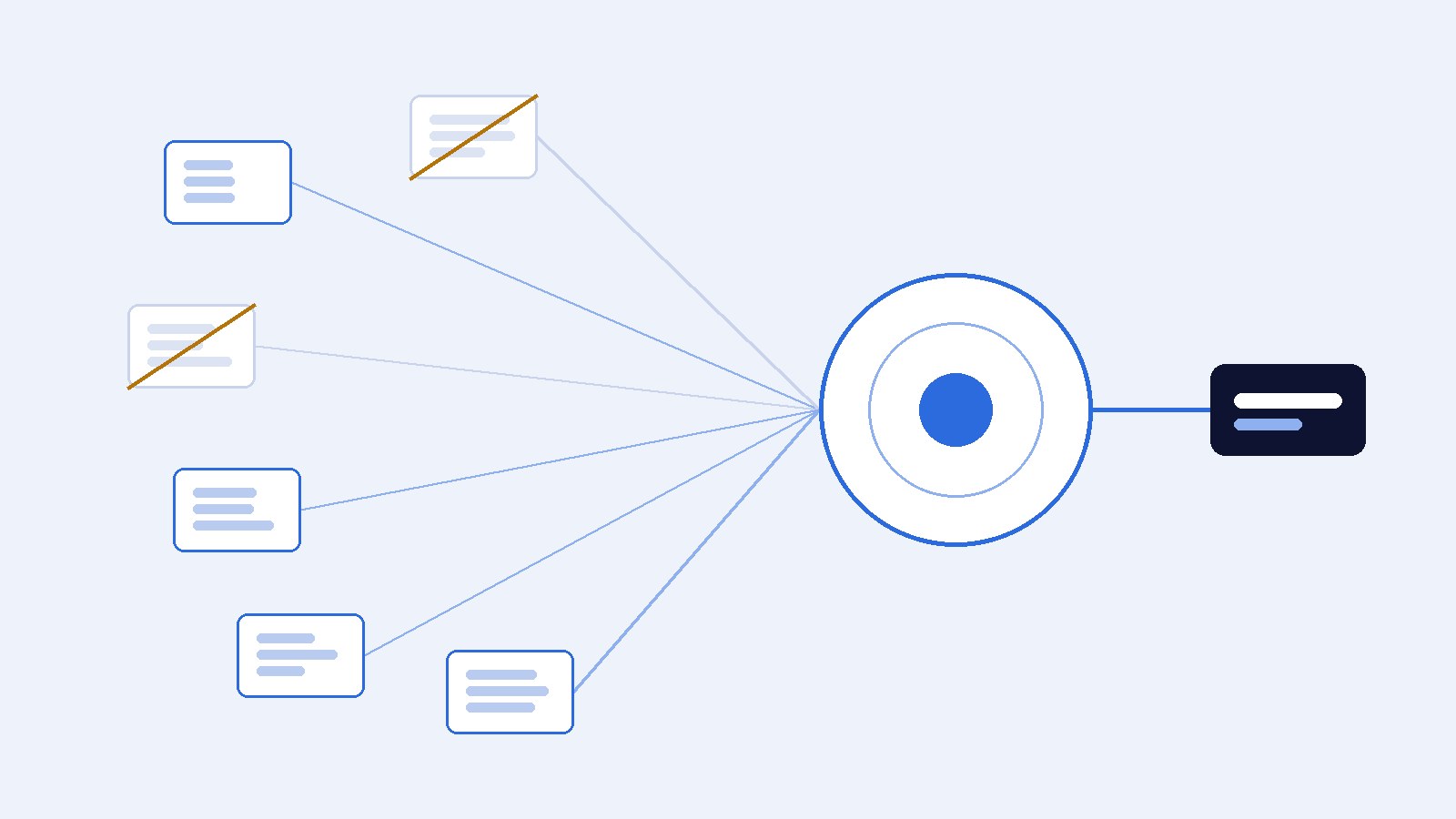
A connector searches each tool when a question is asked and brings back what looks relevant. That is useful, and it is also all it does. It does not know that these four things are about the same subject, or that together they form the answer. Whoever asks gets whichever pieces the search happened to surface.
Found is not the same as answerable
Suppose the search works perfectly and returns every related document. There are now two price lists, three versions of a process and a chat message that contradicts all of them.
Which one wins? Search ranks by relevance to the words in the question, not by which document is authoritative. Making knowledge answerable means doing the work in advance: linking what belongs together, removing duplicates, and structuring it so that the right piece comes back for the right question. It looks simple. It is most of the work.
Nothing tells it what is still true
This is the problem that surprises people most. Ask "what discount do we give this customer?" and a system built on stored documents may answer 15%, citing the 2024 price list. The citation is real. The answer is wrong, because a new contract in March changed it to 10%.
Most company brains are a static memory. They store what was written and repeat it, including after it has stopped being true. Older documents are often the most linked and the most detailed, so they are the ones that come back. The system sounds confident, shows its source, and is out of date.
An employee who has been around for a while would not make that mistake. They know the price list was replaced. That knowledge of what is current is exactly what a document store does not have.
What a living memory does
Solvara Brain is built around this problem. It keeps track of three things a search cannot:
- What replaced what. When a new contract, policy or price supersedes an old one, the old one is not deleted, but it is no longer the answer.
- What still holds. Information that has not been contradicted stays valid; information that has been is marked as such.
- What disagrees. When two sources conflict and it is not clear which is right, that is surfaced to a person rather than averaged into a confident reply.
Once that foundation exists, the model does what you would expect. It answers from the current state of the company, shows where the answer comes from, and stays correct as things change.
Questions to ask any vendor
Whether you are evaluating us or anyone else, these questions separate a connected chatbot from a company brain:
- When two documents disagree, which one does the system use, and how does it decide?
- How does it know that a document is out of date?
- If a decision was made in a conversation and never written into a document, can it still answer?
- When something changes, how long until the answers change?
- What happens to what a person knew when they leave?
If the answer to most of these is "it searches your files", you have a search tool with a very good interface. That may be enough. It is not the same thing.
Final thoughts
Connecting a general assistant to your tools is a good first step, and for many questions it is all you need. What it does not give you is a memory: something that knows not just what your company has written down, but what is true today.
That is the part we build. To see it on your own content, look at how Solvara Brain works or talk to us.
ChatGPT is a trademark of OpenAI and Claude is a trademark of Anthropic. Product descriptions are based on public materials as of November 2026.
See it on your own data
Tell us about your team and we'll show you what this would look like for you.
Book a Demo